

 Key Takeaways
- Discover that 34% of small businesses lack insurance, leaving them exposed to financial ruin from lawsuits or disasters.
- Compare the most common insurance claims against average costs, from $8,000 burglary to $50,000 reputational harm.
- Understand how commercial insurance premiums surged 14.3% in 2021, reaching $359.6 billion across U.S. businesses.
- Learn why business owners aged 18-44 are twice as likely to carry commercial insurance than those 45 and older.
- Analyze the 80% increase in cyber attacks on American businesses and why cyber liability coverage is now essential.
 Table of Contents
What is Commercial Business Insurance?
Commercial insurance, also known as business insurance, is a safety net to be used in the worst case scenario.
Business owners use this insurance to protect their assets from financial losses as a result of accidents, property damage, product or service liability, and other difficult and costly problems.
Many small business owners think they might not need Commercial Insurance, at least initially.
Sorry to break it to you…
If you’re like them, you are asking for trouble.
Small businesses are more affected by financial crises than larger companies.
They are also more vulnerable to strong shifts in market trends.
Even if you think you have the “best small business in the world” and nothing could happen to it, you’ll still take a huge hit if only a small percentage of your customer base stops buying your products or using your services.
Fortunately, there are many types of commercial insurance policies for every business and situation you can imagine.
As your business develops, you will have to figure out which commercial insurance coverage is right for your situation at that time.
More business comes with a higher risk of accidents, lawsuits, and other events which can cost your company more time and more money, potentially leading to utter ruin.
Below, you will find over 57 up-to-date and relevant facts about the different types of insurance, the Commercial Insurance industry, demographics, the common insurance claims business’s make, preventative measures you can take to reduce your risk, FAQs about business insurance, and more.

11 Facts About the Business Insurance Industry in the United States
Insurance providers protect the economic system from total collapse by taking the weight of inherent risks off the shoulders of businesses.
1.
According to the United States Census Bureau, there were 27,104,006 active businesses in US in 2019 and the number is constantly growing! Of those 27 million, 8 million fall into the category of small businesses.
2.
In the United States, all direct insurance policies combined made up a total of 7.565702 trillion dollars in 2020.
3.
Insurance spending (7.57T) in the US for 2020 accounts for 9.447% of the total GDP.
4.
Based on 2020 data, the US accounts for 56.2% of the market share in the OECD for all insurance spending.
The OECD [Organization for Economic Co-Operation and Development] is actively improving the world by setting standards and finding solutions to social, economic, and environmental challenges.
They use data and analysis to help form policies and set international standards.
5.
Commercial Insurance premiums made up 50.2% of all Property and Casualty insurance premiums written in the United States in 2021.
The remaining 49.8% consists of personal lines of auto and homeowners insurance.
6.
$359,600,000,000 ($359.6 Billion) was spent on Commercial Insurance premiums in 2021, whereas $356.3 billion was spent on Personal insurance.
7.
Of the Commercial Insurance lines, there was a total of $184,908,130,000 in losses incurred in 2021 alone.
8.
Of the $1.3516 Trillion spent on insurance premiums in 2021, over half 53% was on Property and Casualty insurance.
This comes out to $715.9 Billion going to Property and Casualty insurance.
The other $635.7 Billion went towards Life and Annuity insurance, making up the other 47%.
9.
During 2021, there were 1,566,900 insurance carriers operating in the US. 628,600 (40.12%) specialized in Property and Casualty insurance.
The rest of the insurance carriers fall into the categories of Life and Health 911,400 (58.16%) and Reinsurers 26,900 (1.72%).
10.
Unfortunately, not all the small businesses who needed insurance actually had any.
An AdvisorSmith study from 2020 on small business insurance claims in the United States revealed only 66.0% of those companies surveyed carried insurance coverage.
11.
Great Places To Work conducted a survey of the Fortune 100 Best Companies to Work for in 2022.
Of those hundred, 5 happen to be insurance providers.
Namely:
- Nationwide Mutual Insurance Company
- The Progressive Corporation
- Allianz Life Insurance Company of North America
- Mutual of Omaha
- Farmers Insurance
5 Facts About Business Insurance Demographics
1.
When it comes to insurance agents in the United States…
- 81.5% are white,
- 11.8% are black or African American,
- 4.1% are asian,
- and 16.5% are hispanic or latino.
2.
In 2021, women made up 50% of the 600,000 insurance sales agents in the United States.
This makes the insurance agent industry one of the most gender neutral occupations.
It’s actually higher than the 46.8% of women who make up the U.S. workforce for all occupations.
3.
Younger business owners (aged 18 to 44) are significantly more likely to carry some form of commercial insurance as opposed to business owners 45 years old and older.
The data presented below shows young owners are TWICE as likely to carry business insurance.
| Age of Business Owners | Percentage Carrying Business Insurance |
|---|---|
| 18-25 | 66.7% |
| 25-34 | 71.4 |
| 35-44 | 76.8% |
| 45-54 | 38.9% |
| 55 and Up | 33.3% |
Dr. Robert Hartwig, co-director of the Risk and Uncertainty Management Center at University of South Carolina’s Darla School of Business, gives two possible reasons why the younger generation is 2x as likely to have business insurance than their elders:
“…Young business owners may be borrowing to start up their business. If so, their mortgage lender will require them to carry commercial property insurance and perhaps other types of insurance as well.”
“Young business owners—who may have invested the majority (or entirety) of their assets into a new business—understand that a failure to protect their investment with insurance could easily lead to financial ruin.”
4.
55.8% of small businesses in the AdvisorSmith survey said they filed an insurance claim in 2020. This is especially interesting considering the fact that 76.2% of businesses said they dealt with an insurable situation during the same year.
So what happened to the other 20.4% of business who didn’t file a claim?
Odds are they decided to forgo the paperwork involved in submitting a claim to their insurance provider.
By paying claims out of the company’s pocket, some people can end up saving the business money because their premiums won’t increase.
Paying out of pocket also eliminates worries about whether or not an insurance policy will fully cover the insurable incident.
5.
Compared to their male counterparts, female business owners were less likely to file an insurance claim even though men and women share similar rates for carrying Commercial insurance (67.8% and 63.2%, respectively).
- 40.4% of female business owners who took the survey reported filing a claim in 2020
- 65.6% of the males surveyed said they filed a claim in 2020
Here’s what Dr. Hartwig, had to say about the fact women submit fewer claims than men:
“Insurance pricing is based, fundamentally, on the frequency and severity of claims made by policyholders. Women, in general, tend to exhibit more caution than men—which in turn can lead to fewer claims. For example, women are less likely to file automobile claims.”

20 Facts about Business Insurance Claims
Commercial insurance policies, otherwise known as business insurance, protect business owners and the economic structure of the United States from the inherent risk of running a business.
Over 7 million small businesses rely on commercial insurance to allow them to continue operating and protect them in the unfortunate event a business is involved in a costly accident or is damaged by something out of their control.
Many businesses have been financially ruined by such incidents.
1.
For every 10 small businesses, 4 of them are likely to file a Property or General Liability insurance claim within their first 10 years of operating, based on statistics from The Hartford.
2.
3 out of 4 small businesses faced a situation in 2020 where they either could have used or did use a commercial insurance policy.
Based on AdvisorSmith’s April 2021 study 76.2% of the 1000 small companies surveyed dealt with circumstances where they would have implemented business insurance.
On the other hand, 23.8% of businesses surveyed were fortunate enough to not have to deal with an incident where insurance would have been necessary.
3.
The most common claim small businesses make is burglary and theft, but that’s not the highest-priced claim businesses are likely to make.
The most expensive claims fall into the category of reputational harm.
This includes damages coming from offenses like slander, libel, and invasion of privacy.
4.
Here is a breakdown of the “10 Most Likely Property and Liability Insurance Claims Small Businesses Made from 2010 to 2014”
| Most Common | Percentage of Total Claim |
|---|---|
| Burglary and Theft | 20% |
| Water and Freezing Damage | 15% |
| Wind and Hail Damage, most notably to the roof or signs | 15% |
| Fire | 10% |
| Customer Slip and Fall | 10% |
| Customer Injury and Damage | <5% |
| Product Liability | <5% |
| Struck By Object | <5% |
| Reputational Harm | <5% |
| Vehicle Accident | <5% |
5.
Based on The Hartford’s data from 2010 to 2014, which includes over 1 million business insurance policies, 1/5 businesses faced incidents of burglary and theft.
In reality, burglary and theft claims averaged $8,000 in damages.
This may seem like a lot at first glance, but when you compare it to the average reputational harm claim of $50,000 it seems pretty reasonable.
When reputational harm claim is filed through a General Liability policy, the average cost climbs to over $75,000.
6.
For your convenience, here’s a deeper look at the average cost of the “10 Most Expensive Property and Liability Insurance Claims for Small Businesses (2010 - 2014)”
| Most Expensive | Average Cost of Claim (Costs increase if lawsuits are involved) |
|---|---|
| Reputational Harm | $50,000 |
| Vehicle Accident | $45,000 |
| Fire | $35,000 |
| Product Liability | $35,000 |
| Customer injury or damage | $30,000 |
| Wind and Hail Damage | $26,000 |
| Customer Slip and Fall | $20,000 |
| Water and Freezing Damage | $17,000 |
| Struck By Object | $10,000 |
| Burglary and Theft | $8,000 |
7.
For a more recent breakdown of the most common situations 1000 small business faced in 2020.
A few of the businesses who participated in the survey actually reported multiple insurable events. Check out the results:
| Event | Percentage of reports | Corresponding Insurance |
|---|---|---|
| Crimes (Burglary, theft, fraud) | 32.0% | Commercial Crime Insurance protects businesses from financial losses due to crimes like burglary, theft, fraud. |
| Employee Injuries | 31.3% | Workers’ Compensation Insurance helps businesses cover the bill for employees injured on the job. This insurance also helps a business provide paid leave to employees who get sick and can’t come in to work. |
| Customer and Client Disagreements | 28.6% | Professional Liability Insurance helps a business mitigate court and lawyer fees as well as the compensation owed for damages caused by the dispute. |
| Digital Security Breaches | 27.9% | Cyber Liability Insurance protects businesses from losses stemming from hacks, viruses, denial of service attacks, and other digital security system malfunctions. |
| Employee Discrimination or Harassment | 27.2% | Employment Practices Liability Insurance provides a business coverage in the event a past, present, or future employee files a lawsuit based on claims of discrimination, harassment, or similar concerns. |
| Property Damage (Fire and Natural Disasters) | 26.5% | Commercial Property Insurance reduces the losses a business experiences from damage to physical property caused by fires, floods, and other natural disasters. |
| Accidents Involving a Company Vehicle | 25.9% | Commercial Auto Insurance covers property damage and liability claims concerning company vehicles. |
| Injuries or Damages Caused by Product Quality or Function | 24.5% | Product Liability Insurance provides coverage in the event damage is caused by a business’s product. This insurance is effective in cases of bodily damage or injury as well as damage to physical property or assets. |
| Customer Injury and Property Damage | 23.1% | General Liability Insurance protects a business in the event customers or another third-party files a lawsuit claiming bodily damage and injury or damage to physical property. |
**The following statistics are grouped according to their position in the above chart. **
8.
The Frankenmuth Insurance Company said their most common business claims have been from cases of burglary and theft.
As a matter of fact 42% of inventory losses accounted for in the US were by company employees.
To fully protect your business from the types of losses caused by theft and burglary you would need a commercial property insurance plan and then supplement it with a crime endorsement and employee theft insurance.
Other common business insurance claims where caused by water, wind and hail, fire, and customer slips or falls.
9.
The Coalition Against Insurance Fraud released a 2022 report on “The Impact of Insurance Fraud on the U.S. Economy”.
They stated in this report that insurance fraud cost the U.S. $308.6 Billion in 2022 alone.
10.
In 2020 47% of Americans experienced financial data theft. From 2020 to 2021, data security breaches increased by 68%.
11.
Based on the FBI’s 2021 Internet Crime Report, there were 847,376 cyber crimes reported by the public. That is a 7% increase from 2020.
These cyber crimes caused a total of $18.7 Billion in damages and losses.
12.
According to the Hiscox’s Cyber Readiness Report for 2022, cyber attacks increased by 80% for American Businesses.
34% of US businesses have a cyber specific insurance policy.
64% of businesses have either a standalone cyber insurance policy or have added one to an existing policy.
The median cost of a cyber attack in the US for 2022 was $18,800 with the highest cost of a cyber attack being around $2,000,000.
Compare this to worldwide cyber attack statistics where the average cost was just under $17,000, with an increase of 29% in the year before.
1 out of 5 businesses which experienced a cyber attack said the survival of their business was seriously threatened.
13.
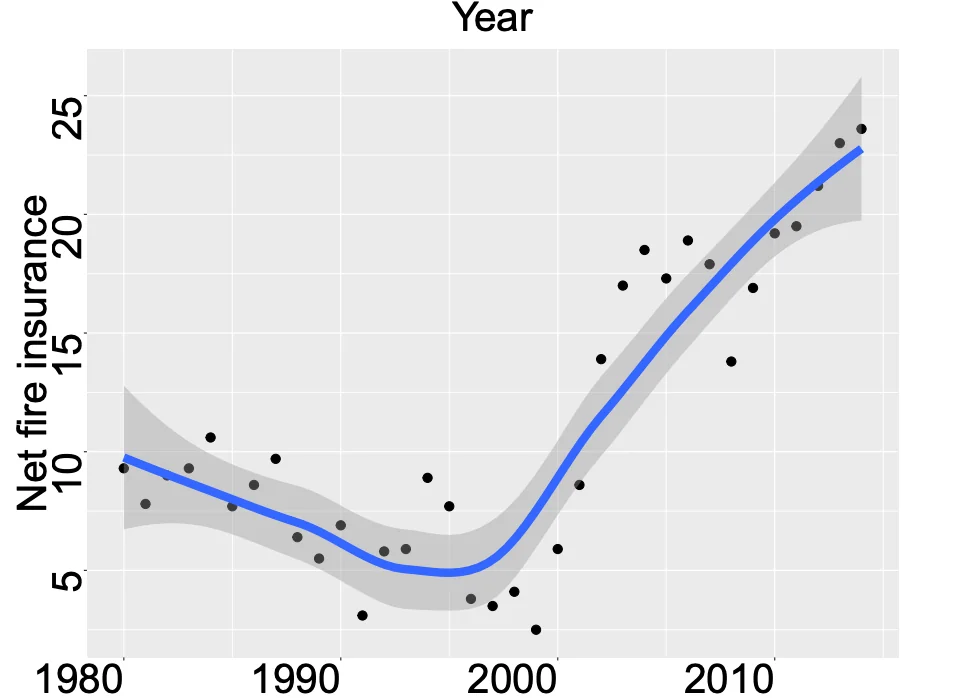
In 2014, $23.6 Billion was spent on all types of fire insurance in the US.
This is 7.2% of all fire costs for 2014 which is estimated to be around $328.5 Billion.
14.
Approximately 10% of small businesses between 2010 and 2014 filed an insurance claim due to a fire with the average cost coming out to around $35,000.
15.
There were 28 large-loss fires and explosions in 2020.
Fires and explosions are considered Large-loss when they cause $10 Million or more in property damage.
2020 alone amounted to 8.1 Billion in damages.
Of these 28…
- 10 caused damages exceeding $20 million.
- 3 caused over $100 million in damages on their own. They were a wild-land fire, a Navy ship fire, and one very large warehouse. These three fires on their own contributed to 7.5 Billion in total damages.
- 23 involved structures and resulted in $822.6 million worth of property loss.
- The other 5 non-structural fires caused $7.2Billion in damages. They consisted of three wild-land/urban interface fires, one vehicle fire, and one fire involving a storage area outside of a structure.
16.
According to the NFPA, firefighters responded to a structural fire in the US every 65 seconds in 2021.
Of the 1,353,500 fires responded to in 2021, there were $15.9 Billion in Property damages.
17.
Non-residential structural fires increased 13.1% between 2020 and 2021.
This means there were $834,208,210 worth of fire damages caused to properties and structures used for mercantile or business purposes.
18.
The average settlement for personal injury caused by product liability in 2020 was $7,058,106.
The average settlement for personal injury caused by general business negligence was $3,110,297.
19.
The average personal injury lawsuit in 2020 was a whopping $2,448,978.
The lowest amount awarded for a personal injury lawsuit in 2020 was only $840 but the highest amount paid was $373,763,109.
Crazy!
20.
According to The Hartford’s data, 35% of all General Liability insurance claims ended in a lawsuit.
13 Statistics about Commercial Insurance Trends
Business insurance preferences have shifted drastically in the last 5 years.
The world has seen the fallout of Covid-19, complete supply chain collapses, cyber security breaches, natural weather disasters, sexual-harassment cases, drug overdoses, a full on war break out between Russia and Ukraine, and many more “breaking-news” events.
Based on these recent developments, the types of insurance policies small businesses need continues to shift as technology advances and business seek new ways to better fulfill their customers’ needs and desires.
1.
With the increasing uncertainty and rapid developments we are seeing in the world, 74.1% of the 1000 business owners who participated in the AdvisorSmith 2020 survey said they planned on either making a first time purchase of Commercial Insurance or increasing their existing business coverage.
2.
Without the right coverage, the 8 million small businesses in the U.S. could be completely decimated by the slightest legal claim or natural disaster.
The price of commercial insurance premiums has been steadily increasing over the past few years and it’s not looking on slowing down any time soon.
| Year | Cost of Commercial Insurance Premiums | Percent Increase |
|---|---|---|
| 2017 | $253,200,000,000 | |
| 2018 | $287,100,000,000 | 13.4% Increase |
| 2019 | $299,300,000,000 | 4.25%increase |
| 2020 | $314,700,000,000 | 5.15% increase |
| 2021 | $359,600,000,000 | 14.3% increase |
3.
Let’s not forget, if an accident happens to an employee while on the clock, on company property, or while using company equipment, the business is held responsible for paying reparations.
Historically, the annual amount of claimed losses has been on the rise.
| Year | Cost of Incurred Commercial Losses | Percent Increase |
|---|---|---|
| 2017 | $136,939,624,000 | |
| 2018 | $148,768,919,000 | 7.85% increase |
| 2019 | $155,085,961,000 | 4.25% increase |
| 2020 | $172,088,377,000 | 10.96% increase |
| 2021 | $184,908,130,000 | 7.45% increase |
4.
Commercial Auto Insurance is currently experiencing one of the greatest consecutive price increases month over month for premiums.
In fact, it’s been increasing for the past 9 and a half years (38 annual quarters).
In 2021 the price increase topped out at 8%.
This is lower than the 8.1% average of price increases for all insurance policies in 2021.
5.
In quarter 2 of 2022 the change in price of Commercial Insurance in the US increased by 10%.
This marks 3 and a half consecutive years where the price of Commercial Insurance has increased.
6.
The percentage of small businesses using Commercial General Liability insurance (CGL) dropped from 61% down to 54% between 2014 and 2018.
The number of small businesses with Business Owner’s Policies (BOPs) also dropped from 52% to 45% over the same period.
This is likely due to the fact the price for BOP coverage and CGL plans have increased steadily over the past few years.
This has led to many small businesses walking away from these plans in favor of reducing their insurance spending.
Unfortunately, this means more and more small businesses, and their customers, are left completely vulnerable to injury and property damage claims.
7.
Of the various lines of commercial insurance policies, Workers Compensation is the second largest making up 6.2% of total net premiums written in 2021.
This comes as no surprise since Workers Comp insurance has seen 8 consecutive years of underwriting profits.
8.
69% of small businesses in 2014 were covered by Workers’ Compensation insurance.
Only four years later, in 2018 only 47% of small business owners held a Workers’ Comp policy.
This drop in Workers Comp insurance seems to stem from a greater overall confidence in the Affordable Care Act.
At its inception the Affordable Care Act, many businesses were skeptical of its effectiveness and hesitated to rely too heavily on a new law.
As the dust settled, we have begun to see more small businesses integrate standardized health insurance coverage into their business model, opting out of classical Workers Compensation policies.
9.
The amount of Product Liability insurance premiums jumped up by 3.5% between 2020 and 2021 from $3.239 Billion to $3.353 Billion.
10.
In 2014, 19% of small businesses purchased Business Interruption insurance and that amount grew all the way to 28% by 2018.
11.
Not only has Business Interruption insurance been on the rise, so has Directors and Officers (D&O) insurance and Errors and Omissions (E&O) policies.
D&O insurance increased by 13% in 2021, according to the CIAB.
The only Commercial Insurance policy with a greater increase during that year was Umbrella insurance with a growth of 20%
12.
Between 2020 and 2021, spending on Property and Casualty insurance increased from $652.8 Billion to $715.9 Billion.
This is a growth of 8.44%.
This is unprecedented especially when you consider that total property/casualty and life/annuity insurance premiums only increased from 51.1% in 2020 to 53.0% by 2021.
13.
According to the Insurance Information Institute, the total number of insurance brokers and insurance sales agents will increase 9% by 2024.
Based on the trends mentioned above, with more and more business owners wanting to protect their assets, it makes sense why the insurance industry as a whole is projected to see a lot of growth in the coming years.
Don’t Be Like The Other Companies
Unless the industry or state you work in makes commercial insurance mandatory, most business owners will put off buying insurance for their company, sometimes until its too late.
Make sure you get insurance… BEFORE you need it.
A proper business provides not only to the customers in the marketplace but also to the community.
If a business fails, the consequences may be greater than you can imagine.
Don’t just think about the financial aspect but you should also take into consideration the emotional, mental, and psychological toll it can take on your family, community, and other businesses which may rely on your goods and services.
Not all insurance is equal and the same goes for insurers.
Some insurance providers cater specifically to the needs of small business and can meet your needs and your budget, while other providers have larger and more expensive policies designed to handle the needs of large scale businesses.
The best thing you can do right now is brainstorm where your business faces the highest risk.
The money you spend on insurance premiums may seem like an unnecessary expense when it’s not actively doing anything for your business and it seems like it’s just a dormant money pit.
However, if a situation arises when you need the insurance coverage, you’ll be glad you made the right decision to protect your assets.
Speak with your insurance provider and take a look at what options are available. Every business is different.
Take the Initiative to speak with insurance professionals to come up with the best coverage and deductibles to meet your specific needs.
FAQs
What is the largest insurance company in the world?
Chubb Ltd. wrote $22,323,908,000 worth of commercial insurance premiums in 2021, making them the largest insurer in the U.S. (over 5.6% market share). They are followed by The Travelers Companies Inc. and Liberty Mutual. On a global scale, Berkshire Hathaway holds the top spot for revenue from property and casualty insurance; the next two largest are Ping An Insurance and China Life Insurance, both based in China.
Learn More...
In 2021, Berkshire Hathaway brought in $276 billion from property and casualty insurance. Ping An Insurance had revenue of about $200 billion and China Life Insurance about $157 billion.
The rankings differ by line of business (e.g., commercial vs. life/health) and by region (U.S. vs. worldwide).
Do corporations and LLCs need liability insurance?
The protection offered by LLCs and corporations only covers your personal assets (accounts, investments, vehicles, properties). It does not meet the minimum company insurance requirements set by most states, and malpractice or negligence can void that protection.
Learn More...
If members or shareholders blur the line between business and personal assets, it is known as piercing the corporate veil, and courts can hold them personally liable.
Lawyers can find circumstances where the corporate veil is pierced even when owners have followed rules. Without the right insurance policy or bundle, you risk losing your business and personal assets.
Does my business need insurance?
Without commercial insurance you put yourself and your business at risk. Accidents, emergencies, theft, and lawsuits can wreak havoc on your finances; if the business cannot pay, you may have to pay from personal savings and investments.
Learn More...
Depending on your product or service and state, you may be required to have certain policies (e.g., Workers' Compensation if you have employees).
Some licenses, certifications, and permits require insurance. Real estate firms often require tenants to carry insurance, and some suppliers require it to do business with them.
Is Workers' Compensation insurance important for my business?
If your company has employees on payroll, you typically need workers' compensation insurance. In the event an employee is injured and you do not have coverage, they can sue for medical bills, rehabilitation, missed wages, and more.
Learn More...
Laws, administrative bodies, and claim structures for workers' comp vary by state. Speak with legal professionals and your state insurance commissioner to understand your obligations.
What if business insurance is too expensive?
About 40% of small businesses remain uninsured to save money, but one serious accident or disaster can cost far more than premiums and can threaten both your business and personal assets.
Learn More...
A Business Owner's Policy (BOP) bundles coverage and is often more affordable than buying each policy separately. You can also consider a higher deductible to lower premiums, but that means paying more out of pocket when a claim occurs.
How do I get the best insurance rates for my business?
Practice risk management so you are not over- or under-insured, and compare bids from multiple insurance companies. The price you pay is often based on your claim history—fewer unnecessary claims can help keep rates lower.
Learn More...
Identify where potential losses may occur (theft, injuries, fraud, natural disasters). Calculate the financial risk of each and how often it might happen. Brainstorm ways to prevent or reduce these events and how much insurance would cover. Use that to decide which types of coverage are right for your company.
Paying out of pocket for small, infrequent losses can avoid premium increases. It is common for businesses to change providers when they find a better fit for their needs and budget.
What deductibles do I need?
The higher the deductible, the lower the cost of your insurance premiums. The minimum deductible on a typical business insurance policy is often around $250 per incident.
Learn More...
Consider what your business does, where it is located, and the likelihood of a claim. Many providers do not offer the same deductibles for liability insurance as they do for property insurance.
When should I change my insurance policies?
Reassess your business's current insurance and risk at least once a year—ideally biannually or quarterly—and after any significant change (e.g., new location, new services, more employees).
Learn More...
Regularly reviewing your policies helps you avoid being underinsured for your current situation or paying for coverage you no longer need.
Where does this statistics data come from?
The data comes from official or cited sources such as government agencies, surveys, and industry reports; check the article and sources section for specifics.
Learn More...
Many business statistics use U.S. Census Bureau, BLS, BEA, or other federal data.
Industry and trade groups often publish benchmarks and surveys.
Always verify the date and scope of the data when applying it to your situation.
How can I use these statistics for my business?
Use them to benchmark your performance, plan strategy, understand market and industry trends, and support decisions with evidence.
Learn More...
Compare your metrics (e.g., revenue, employment, growth) to industry or regional norms.
Use trends to anticipate demand, hiring, or investment needs.
Cite statistics in business plans, pitches, and internal planning.
How often is this data updated?
Update frequency depends on the source; government data is often annual or quarterly. Check the article or source for the latest vintage.
Learn More...
Census and BLS data often have a lag of several months to a year.
Some dashboards and tools are updated more frequently.
When in doubt, go to the primary source for release schedules.
What should I be careful about when using business statistics?
Be aware of definitions (e.g., what counts as a small business), geography and time period, and whether the data applies to your industry or situation.
Learn More...
Definitions of firm size, industry, and geography vary by dataset.
Averages and aggregates can hide variation; look at breakdowns when available.
Use statistics as one input alongside your own data and judgment.
Who can help me apply this to my situation?
Consultants, accountants, and industry advisors can help you interpret data and apply it to your business; Business Initiative offers consultations for strategy and planning.
Learn More...
A consultant can help you find the right benchmarks and set realistic targets.
For tax and structure questions, work with a qualified professional.
Use the data to ask better questions in those conversations.