

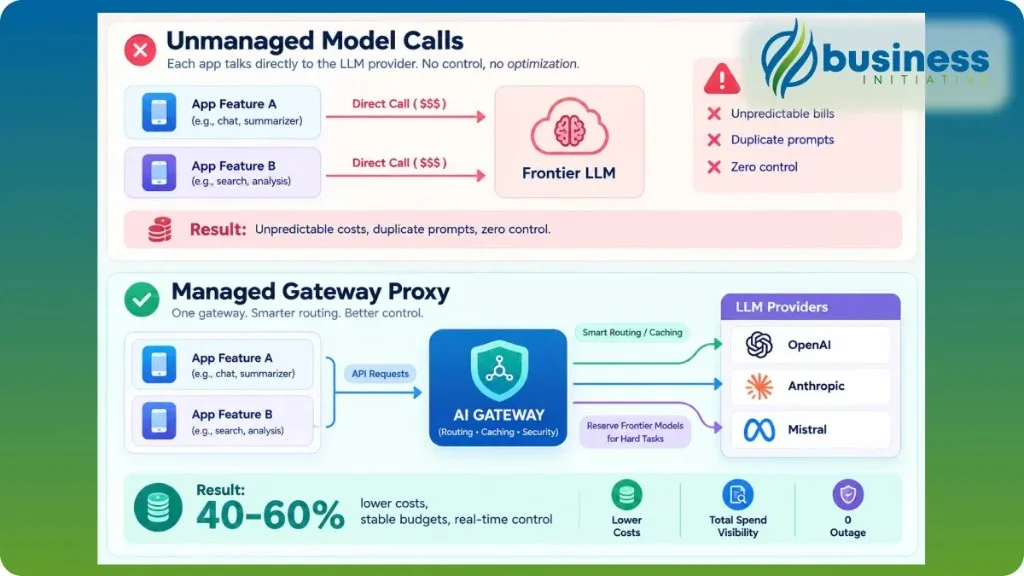
The creation of an AI feature is always fun, but its scalability comes with a painful economic lesson. Unlike fixed SaaS subscriptions or traditional cloud servers, generative AI relies on token consumption. A single viral week, an unoptimized prompt template, or an autonomous AI agent loop can double your API bill overnight.
When usage scales, keeping AI costs predictable becomes a top engineering priority. Leading platform teams do not achieve financial control by restricting developer creativity. Instead, they centralize model access using enterprise proxy layers.
Evaluating the top AI gateway providers reveals how modern companies eliminate billing surprises, optimize model usage, and scale their AI features without sacrificing profitability.
The Hidden Friction of Token Economics at Scale
Traditional cloud budgeting relies on predictable resource usage. You provision database instances or compute clusters based on expected web traffic.
Generative AI breaks this model. Token-based pricing depends on both input prompt size and output completion length. As users interact with your application in unpredictable ways, token volume fluctuates wildly.
Without unified oversight, three primary issues drive up inference costs:
- Over-Provisioned Model Choice: Developers frequently default to top-tier, expensive models for simple tasks like text classification or basic summarization.
- Redundant Prompt Ingestion: Applications repeatedly send identical or semantically similar prompts to external APIs, paying full price every single time.
- Runaway Agent Loops: Autonomous AI agents can execute endless API calls during edge-case errors, consuming entire monthly budgets in hours.
The Four Pillars of AI Cost Predictability
To prevent unexpected billing spikes, engineering teams deploy four core technical mechanisms through a central gateway layer:
- Semantic Caching: Traditional caching requires exact text matches. Semantic caching uses vector similarity to identify queries asking the same question in different words. Returning a cached answer costs zero tokens and reduces latency to milliseconds.
- Dynamic Model Routing: Smart routing engines evaluate incoming requests in real time. Simple tasks automatically route to smaller, cost-effective models, reserving expensive flagship models strictly for complex reasoning.
- Hard Token Budgets and Rate Limits: Token bucket rate limiting caps daily or monthly consumption per application, user, or environment. If an agent enters an infinite loop, the gateway cuts execution before the invoice inflates.
- Automated Provider Failover: If a primary model vendor experiences downtime or hits rate limits, the gateway automatically reroutes requests to a backup provider, protecting uptime without manual engineering intervention.
Evaluating the Top AI Gateway Providers for Financial Governance
The choice of a proper infrastructure platform defines how successfully you will be able to manage costs along with maintaining a high speed of engineering processes. Analyzing the top AI gateway providers gives technical experts the full picture of how to route models and ensure financial governance.
Modern enterprise solutions stand out by pairing technical routing with organizational controls:
- Nexos.ai: The enterprise AI gateway coupled with a universal AI Workspace that provides users with token analytics, smart routing through 200+ models, automatic failover and strict budget management for both technical and non-technical teams.
- Portkey: Focuses on production AI app routing with robust guardrails, fallbacks, and execution observability for engineering teams.
- LiteLLM: Provides a popular open-source, OpenAI-compatible proxy that standardizes API formats and supports basic team budget limits.
Unmanaged API Access vs. Centralized Gateway Control
| Feature | Unmanaged API Calls | Centralized AI Gateway |
|---|---|---|
| Model Selection | Hardcoded by developers; often over-provisioned | Dynamic routing based on cost, speed, and task complexity |
| Repeated Prompts | Reprocessed every time at full API price | Cached via semantic similarity for zero-cost responses |
| Cost Control | Post-billing invoice reviews | Real-time token budgets, user rate limits, and spend caps |
| System Resilience | Provider outages crash application features | Automatic failover reroutes traffic instantly |
| Average Cost Reduction | Baseline expense | 40% to 60% savings on inference costs |
Actionable Playbook: Scaling AI Without Blowing Your Budget
Regaining financial predictability does not require rebuilding your software stack. Platform teams can follow this implementation playbook:
- Centralize Model Endpoints: Route all application requests through a unified gateway endpoint instead of managing scattered API keys.
- Implement Tiered Model Routing: Map non-critical prompts, summaries, and classifications to lightweight models.
- Enable Semantic Caching: Set up caching policies for high-frequency user queries to cut unnecessary API calls.
- Set Enforceable Spend Limits: Define hard token caps per project, team, and agent session to eliminate surprise bills.
Secure Your Scaling Strategy
As generative AI becomes core to modern software, variable costs do not have to threaten your operating margins. By consolidating model access via an enterprise AI gateway, scale-up businesses attain full predictability of total cost, improved application reliability, and total operational control.
Frequently Asked Questions
How much can an AI gateway lower monthly inference bills?
Using techniques like semantic caching, intelligent routing, and token rate limiting, enterprises tend to reduce their LLM inference costs by 40% to 60% without any sacrifice in terms of quality.
Does routing requests through an AI gateway introduce latency?
No. High-performance gateways add minimal overhead (a few milliseconds), which is easily offset by instant response times from semantic cache hits.
What happens when an AI model vendor experiences an outage?
A centralized gateway automatically detects provider failures or rate-limit errors and instantly reroutes incoming traffic to a designated fallback model.